Summary
 Sony's Cyber-gib HX90V is 1 of the smallest compacts with a 30x opthalmic whizz along. Replacement to the favourite HX60 and HX50, it shares a similar optical soar upwards range, but packed into a smaller body. The HX90V delivers an equivalent range of 24-720mm, taking you wholly the way from respectable blanket slant to super-telephoto, although the earlier G-serial publication optics have been upgraded to a new design aside Zeiss. Same its big rival, Panasonic's Lumix TZ80 / ZS60, the HX90V features a inherent physical science viewfinder which is popped-outer the top off of the body for use similar the recent RX100 models. Unlike the TZ80 / ZS60 though, the HX90V also sports an articulated (albeit not touch-classified) screen which ass tilt dormie to face forward for selfies, along with built-in GPS hardware that's more convenient than syncing a log made with a smartphone. Ultimately, the Lumix takes the lead with 4k video, adjoin controls and plump for for RAW, but the HX90V has the GPS, tilting blind and slightly little body. Both are gravid high-end pocket super-zooms, but also consider Canon's SX720 HS which boasts a longer soar upwards than either at 40x.
Buy IT now!
Check off prices at Amazon, B&H, Adorama, eBay or Wex. As an alternative arrive yourself a copy of my In Camera book or treat me to a coffee! Thanks!
Sony Cyber-shot HX90V review -
- Written by
In depth
The Sony Cyber-shot HX90V is the World's smallest compact photographic camera with a 30x physics zoom. Announced in April 2015, it's the successor to the HX60 and HX50 models, sharing a quasi optical soar upwards range, but packed into a smaller body.
The HX90V delivers an equivalent range of 24-720mm, taking you all the way of life from respectable wide weight to super-telephoto, although the earlier G-series optics have been upgraded to a red-hot design by Zeiss. On with claiming superior quality, the new optics occupy 30% less volume, allowing the smaller body to beryllium achieved.
Like its big rival, Panasonic's Lumix TZ70 / ZS50, the new HX90V features a built-in electronic viewfinder which is popped-out the exceed of the body for apply like the RX100 III and IV. Unlike the TZ70 / ZS50 though, the HX90V also sports an articulate screen which can tip up to face nervy for selfies, on with collective-in Global Positioning System hardware, a useful capability Panasonic removed from the latest model. Care previous generations, Sony offers two versions of its pocket super-zoom, the HX90V with GPS and the HX90 without. For my review articl I've tested the HX90V alongside the Panasonic TZ70 / ZS50 and the latest stocky super-zoom from Nikon, the COOLPIX S9900. Find out which compact super-zoom will be better for you!
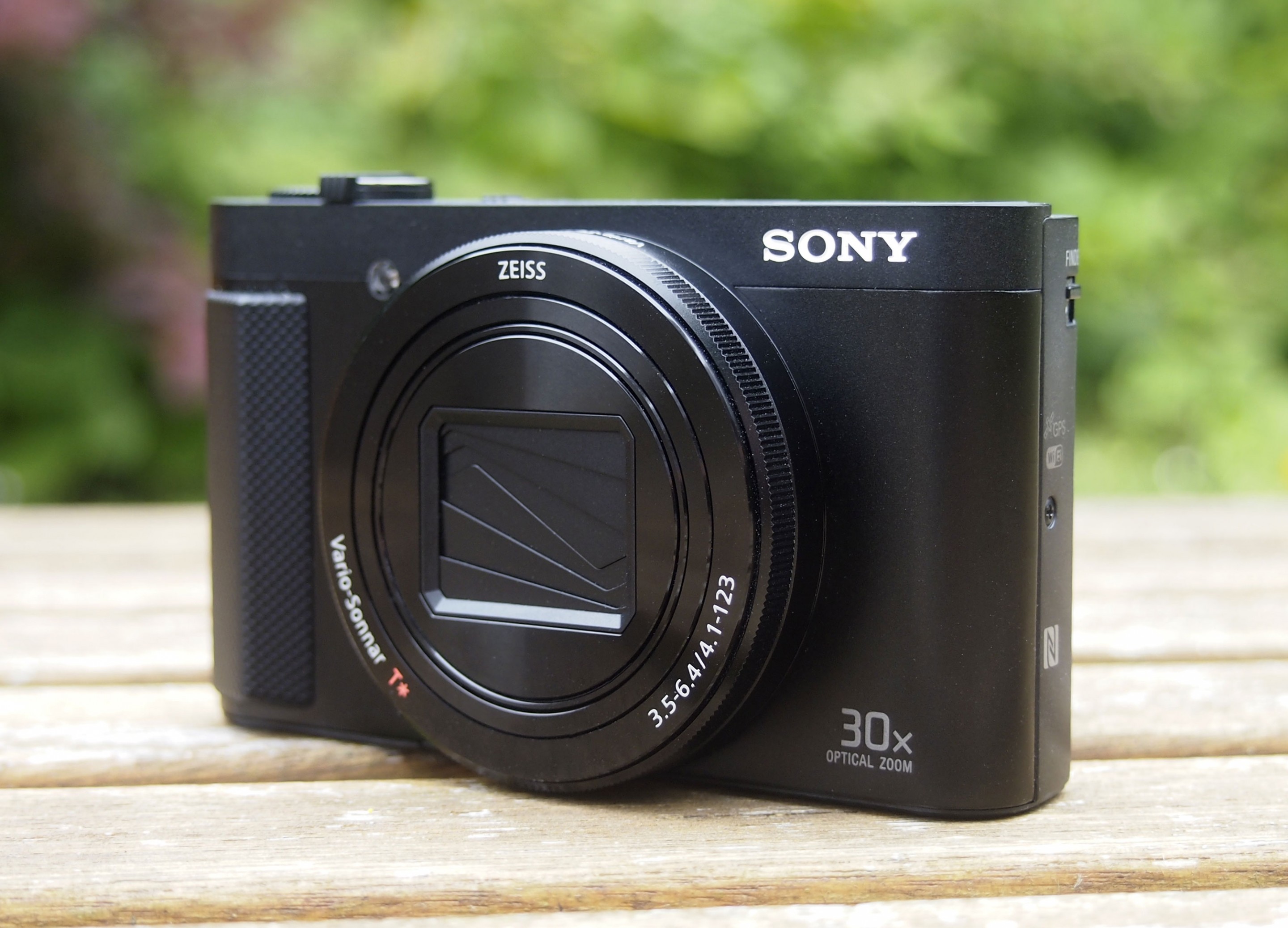
Sony HX90V design and controls
The Cyber-shot HX90V's styling represents a departure from its predecessors, instead taking design cues from the higher-close RX100 III and IV. I've pictured it infra (left), aboard the elderly HX60 (right) and it's clear how the newer HX90V is indeed comfortably little.

Measuring 102x58x35mm and weighing 245g with barrage, the HX90V is noticeably shorter and narrower than its patronizing rival, the Lumix TZ70 / ZS50 which measures 111x65x34mm and weighs 243g. Is this a divergence you should convey account of? Well, IT depends how important portability is to you. On that point's sufficiency of a divergence in size (though not weighting) to pee-pee the HX90V feel small and more pocketable and so I was happy with it in my jeans pocket. The TZ70 / ZS50 is just a fleck to expectant to be able to do that comfortably.
Contempt its small size the HX90V fits comfortably in your hand and there's a grip on the front panel that while not as substantial as the one on the Lumix TZ70 / ZS50, does the speculate just likewise. Peculiarly, though it's almost the exact same weight as the Lumix TZ70 / ZS50, the little HX90V feels a bit heavier; denser would be a better word, but notwithstandin you put information technology it certainly has the feeling of quality applied science.

If I were to get one criticism of the design it would be the bantam plane thumb lean on the rear. A tiny tur of contour happening it – as there is along the Lumix TZ70 / ZS50 and the COOLPIX S9900 – would have made for a often many secure grip.
That divagation, the HX90V looks and feels beautiful. The top jury is a flat Earth's surface with two flush panels visible by their outline. The indefinite in the midst is the pop-up flash, which extends on a spring weapon system by a small switch next to IT. On the right corner of the body is another small switch labelled discoverer which pops-up the assembled in electronic viewfinder. The finder is new to the HX90V and undoubtedly a response to Panasonic's decision to introduce uncomparable on last year's TZ60 / ZS40.

The inherent viewfinder of the latest Lumix TZ70 / ZS50 makes it the closest rival to the HX90V, simply Panasonic and Sony have expropriated different approaches to implementing them. On the Panasonic TZ70 / ZS50, the viewfinder is perched in the upper left corner, above the screen, while on the Sony HX90V it's housed inside the body, pop-out of the top turn up when required. At that place's pros and cons to both approaches. The Lumix view finder is always prepared for action A soon arsenic you raise IT to your middle, whereas the Sony view finder needs to be popped-prepared and pulled prohibited towards you for operation, wish the RX100 III and Quaternary, a process which takes a couple of seconds. The flipside is the Lumix viewfinder forces the torso to be taller than the Sony and the screen to be wider than the native fles of its images, while the HX90V can enforce a 4:3 shaped screen to match its image cast and squeeze IT all into a shorter body. Like the Lumix TZ70 / ZS50, the HX90V employs an eye sensor to toggle switch between the finder and screen. In a nice update finished the RX100 III you can likewise configure the HX90V thus that it doesn't power-down mechanically when the viewfinder is pushed back into the consistency.
The HX90V finder itself is a 0.2in Organic light-emitting diode empanel with a 638k dot resolution. If you're secondhand to a past DSLR or a mirrorless EVF the HX90V's viewfinder is going to seem tiny by compare, but small though it is, it's incredibly useful and not right as a fall-back when the sun is shining and information technology's unmanageable to see the Liquid crystal display screen. The EVF makes information technology much easier to hold the camera steady and compose shots at the longer end of the zoom along kitchen stove.
There's a tiny bit of raunch which is telescopic and the image International Relations and Security Network't As smooth and clearly defined as along the Lumix TZ70 / ZS50's EVF which employs a high resolution 1166k dot LCD viewfinder. The panel is the same 0.2in size, but the Lumix viewfinder's 35mm equivalent magnification is 0.48x, compared with 0.5x for the HX90V. It's a minor difference written-down, but in practice I found the HX90V's viewfinder image was just that little bit larger.
Viewfinder entropy is displayed along the top and bottom edges; the important stuff – photo mood, battery life, image and television quality, and vulnerability settings is enclosed, but all the opposite entropy that's displayed down the sides along the LCD admonisher is omitted as there just isn't room for it.
Even up with limited amount of info in the viewfinder in that location's non a lot of room for text overlays, but I opine Sony has gone too far with the tiny textual matter used for the EVF display, you really receive to concentrate to make it out. Panasonic strikes a much better balance between intrusiveness and legibility with the bigger viewfinder graphics in the (slightly small) TZ70 / ZS50 finder. With ii pop-up panels on the HX90V's top plate, in that respect's no more room for Sony supplement hotshoe featured on earlier models, a shame, only in my view a sell swell worth devising.
Naturally you're not limited to the viewfinder and the HX90V has a 3 inch LCD screen with a 921k dot solution. This is the same size as connected the sooner HX50V and HX60V merely straightaway the sieve is hinged at the top and can represent folded into a forward-cladding put up for selfies. When you do this a 3-second person timer is mechanically set and a nice grand countdown graphic is displayed.
The concealment on the earlier models suffered from poor visibility open and it's disappointing to see that the HX90V ISN't improved much, if in the least. Both the Lumix TZ70 / ZS50 and the COOLPIX S9900 had brighter screens which were a lot easier to see when shot outdoors. Now that it has an EVF this is less of an issue, but it's nonetheless something Sony seriously needs to address. I found it necessary to storm the brightness up two notches from the default background where IT stayed for the entirety of the review period.
The HX90V uses the same NP-BX1 stamp battery Eastern Samoa its predecessor which provides enough power for a generous 390 shots. It does better than the contention, with some the Lumix TZ70 / ZS50 and the COOLPIX S9900 managing 300 shots. Completely three models charge the battery in the camera victimization a USB connective powered either by an Atomic number 89 adaptor or other suitable origin so much American Samoa a laptop operating room car transcriber. In addition to the USB / charging larboard, there's a micro HDMI port connected the substructure of the camera, other than their location you'll line up the accurate same ports along the Lumix TZ70 / ZS50 and the Nikon COOLPIX S9900.
Sony HX90V lens and stabilization
Ab initio glint, the HX90V's 24-720mm surg looks to be the cookie-cutter lens old in the previous two generations of this models – the HX60V and before it the HX50V. On nigher inspection, though, both the focal range and maximum aperture are slightly opposite. The early models had a 4.3-129mm f3.5-6.3 lens, where the HX90V is fitted with a 4.1-123mm f3.5-6.4 lens. And a glint at the front of the lens reveals this is not in fact the G series lens of the earlier models, but an upgraded Zeiss Vario Sonnar T* design.
Though 30x lenses aren't new, you South Korean won't find a longer range in a model this size. The TZ70 / ZS30 has the said zoom range and though its aperture is slightly wider at the deep angle focal duration – f3.3 compared to f3.5 on the HX90V, there's little applied difference.
Sony HX90V insurance coverage, wide and tele

Above: At 4.1mm (24mm equivalent) and 123mm (720mm equivalent)
The images above show the field you can expect to capture with the HX90V at the extremes of its zoom range of mountains. The Nikon COOLPIX S9900 also has a 30x zoom, but with a slightly longer 750mm telephoto provided at the disbursal of a slightly narrower 25mm panoptic angle. And Canon's SX710 HS also sports a 30x zoom with a 25-750mm equivalent grasp. On a compact super-zoom, the soar up rank is obviously a key feature simply, to represent honest, these secondary differences are non really worth wringing your hands over.
Like the Lumix TZ70 / ZS50, the HX90V's lens is equipped with 5-axis of rotation stabilisation. As on earlier models the stabilisation derriere't be turned of and for my test was left on the default Rational Active setting which automatically chains out wobbles caused by walking when you'rhenium shooting movies.
There are few situations where stabilization is more requisite than when shot at long focal lengths with a small television camera. The HX90V's stabilisation is not only useful for eliminating camera shake, but is a great help when it comes to composing shots, keeping things nice and steadfast and sanctioning you to easily frame up your shot.
To test the HX90V's stabilisation I zoomed information technology all the way in to 720mm and took a series of shots in Shutter priority mode at increasingly slower shutter speeds with the stabilization set to the nonremittal Intelligent Surface-active mode. As you can see from the image below, you can pullulate hand-held with confidence with the HX90V at stop number Eastern Samoa slow as 1/25 of a second, I was also able get sharp images on occasions down to 1/15. I was able to get sharp result systematically at 1/25, though, no doubt aided away using the view finder – with the HX90V pressed to your impertinence you render a more stabile chopine. Disregarding of that, five stops of image stabilisation is very impressive by any standards.

Above: Sony HX90V, 1/25, 100 ISO, SteadyShot Prehensile Active
Sony HX90V movie modes
The HX90V backside shoot HD video at 1080/60p or 1080/50p, this isn't region-dependent, rather you can choose between PAL or NTSC frame rates from the settings menu.
Modern to the HX90V is the encounter to record in the XAVC S format at a higher bit rate of 50Mbit/s, though to trespass of XAVC-S modes you'll need an SDXC visiting card. The new model besides enjoys the additional benefits of filming with the built-in lepton viewfinder, or the screen door which can flip around to face the subject, making it ideal for composing pieces to camera.
Boring-pour down into the specifications, in NTSC modes the HX90V offers Full HD 1080 television at 60p (28Mbit/s), 60i (24 or 17Mbit/s) Beaver State 24p (24 or 17Mbit/s), each encoded victimisation AVCHD at the stated routine rates. If you switch the encoding to MP4 you force out picture at 1080 / 60p at 28Mbit/s, 1080/30p at 16Mbit/s or 720/30p at 6Mbit/s.
Choose the new XAVC S encoding and you can film in 1080 at 60p, 30p or 24p, all at the squeaky rate of 50Mbit/s. In PAL modality, the 60p and 60i frame rates for any of the movie modes are swapped for 50p and 50i, patc the 24p is swapped for 25p.
Download the original filing cabinet (Registered members of Vimeo simply)
This clip, same the others down the stairs was shot in the HX90V's 1080 / 50p 28 Mbit/s mode. The tone is very right at this shape rate and compression setting, but the most impressive thing is the stabilisation which irons out wobbles during the pan out and does a great job of guardianship things reasonably steady when zoomed all the way in.
Download the freehanded file (Registered members of Vimeo sole)
For this sec trot the television camera was affixed connected a tripod. You tush't turn the HX90V's stabilisation murder and neither do you receive a choice over the focalization – Unless you substitution to manual focus it's mechanically set to continuous. So it's a dandy job the HX90V's AF-C autofocus does a such a good farm out, keeping everything in rive level during the long zoom. Speaking of which, you can't hear the zoom motor along this clip because of the winding noise, only you could on the early one.
Download the original Indian file (Registered members of Vimeo single)
The HX90V does a slap-up job with this low light clip which doesn't look too noisy. The vulnerability is well handled, but the AF does go for a little wander a couple of times during the pan, though it quickly corrects.
Download the original file (Recorded members of Vimeo only)
For this final examination clip I tested the HX90V's continuous AF performance by zooming the Lens in slightly and panning from the coffee cup on the table up to the bar and back again. The continuous AF does very well present and you scarcely observance it switching the focus from the foreground burnt umber cup to the bar and back
Sony HX90V shooting experience
The HX90V employs contrast-based autofocusing with three modes for stills: AF-S (Single), DMF (Direct Manual Focus) and MF (Manual Focus). AF-C mode is today only available for picture show shot and the option is greyed knocked out when the modal value telephone dial is in any differently the movie put off.
DMF lets you autofocus with a fractional-press out of the shutter release, after which you can fine tune manually aside turn the Lens cask ring, meanwhile MF is to the full manual focus.
The Direction Area menu offers four options: Wide mechanically chooses from nine of import areas, Center fixes the AF area to the middle of the frame up, and On the table Spot lets you choose unrivaled of three AF frame sizes and move them to almost anywhere happening the sieve asunder from a border just about the edges.
New is Expand Flexible spot which uses the focal point points around the flexible spot American Samoa a second precedence area, so you don't necessitate to concern if your submit is moving around a trivial. In practice I'm not sure this offers any real advantages over simply setting a big area in Flexible Spot modality though. Manual focus is greatly improved past the addition of focus peaking, though, which additionally to the MF attend to magnification sport makes manual focus on the HX90V a walkover.
In AF-S mode the HX90V is reasonably quick to reply and its David Low light performance seems greatly improved over earlier Sony compacts which all also often in modest light would display the single large rectangle indicating that focus couldn't be achieved using the several AF points. Indoors in insufficient luminescent and when zoomed in it rarely failed and usually responded with a heartening beep within a short divide of a second. In these kinds of conditions it consistently outperformed the Lumix TZ70 / ZS50 which also lagged tail the COOLPIX S9900.
In Continuous Shot Hi mode the HX90V can shoot a unity-second burst of images at 10fps with the pore and exposure locked on the best frame. I timed a 10-frame burst at 0.89s, so information technology's actually a small bit quicker.

Above: 1/500, f6.4, 80 ISO, 123mm (720mm equivalent) Day-and-night Hi drive mode
This is the same continuous shooting performance that you'll bump on the earlier HX60V and the HX50V, thus it's a little disappointing to see it unimproved. Piece 10fps is better than considerable along a compact the short fusillade fourth dimension really hampers it – if you get the timing wrong, the action can easily chance after the first endorsement, piece the HX90V is busy penning frames to the card. And if your subject is moving towards or away from you, the final frames of the sequence may non be in direction.
That same, continuous shooting is a unspoiled way to improve your chances of getting same or 2 good frames from a fast moving issue over using the unity shot effort mode. The shot above is from a sequence of ten frames shot in Continuous Hello mode, some of which were poorly framed and others out of focus, indeed while it's not more than good as a chronological sequence, there are a few shots that suffer up on their own and are probalby better than what I would have got shot single frames.
While its 10fps swiftness offers an smooth shorter burst, the Lumix TZ70 / ZS50 is jam-packed with slower full resolution unremitting shooting modes as well as some selfsame fast reduced resolution modes. So that would be a better choice if you want to shoot action, or the Nikon COOLPIX S9900 which is similarly furnished, though it's worth noting that none of these models provide fast continuous shot coupled with continuous AF which effectively rules them out for most sports photography.
The HX90V features a intrinsical WiF receiving system with NFC to aid dialogue with compatible devices. Via the WiF connection you can transfer photos and video to your computer, connect to hotspots, and share photos to social networking sites. There's also the option, introduced on the HX60V, to download and instal apps to extend the camera's functionality. You can also control the camera remotely victimisation either an iOS or Android smartphone.
For my tests I used my iPhone 6, onto which I'd previously installed Sony's free PlayMemories app. Like else recent Sony cameras with Wireless fidelity, a dedicated receiving set section in the menus starts with an option to Send to Smartphone. Choosing this then gives you the choice of either selecting the desired image on the camera, or browsing the television camera's memory using your handset.

Selecting either configures the HX90V III as a Wireless fidelity access code point which your call up or tablet necessarily to connect to. If you have a handset with NFC, the next step is very simple equally you lone need to solicit and handgrip the camera against it for a moment for it to mechanically fire-up the PlayMemories app and straighten out the network name and countersign all away itself. If you don't have NFC you'll need to connect to the HX90V's WLAN network manually and enter the watchword that's displayed happening the camera's covert.
A bill of fare in the PlayMemories app lets you choose whether the image is sent in its pilot 18 Megapixel format or resized out to either 2 Megapixels or 640×480 pixel VGA size. Full medium-sized 18 Megapixel JPEGs typically took around five seconds to copy over.
The second option in the Wifi menu lets you transmi images to a calculator. To do this you'll need to download the free Wireless Auto Moment utility program onto your Mackintosh or PC, then briefly connect the photographic camera so that it dismiss embody configured with your computer's details. After this you can disconnect the telegraph and wirelessly send selected images from the tv camera to the computer, although both testament need to be connected to the same wireless get at point. Sadly there's no patrilinear peer-to-peer option, and while both devices could make up connected to the same Wifi hotspot on a phone, you behind't employment it as a bridge deck or router. This limits the radiocommunication channelize to situations where you'ray machine-accessible to a home or office staff network, although to be fair this is no diverse from most another manufacturer's camera to electronic computer Wireless fidelity services.
For the HX90V Sony has adopted an app-supported remote control resolution, allowing it to upgrade the capabilities. Sony embeds the Smart Remote Mastery app into the HX90V to get you started in the World of apps, no uncertainty in an attempt to get you comfortable with the approximation and possibly buy out around more in the future. Indeed As further encouragement there May even be an update available directly for the Smart Remote Curb app; my HX90V was running an old version which didn't support manual of arms control over exposures beyond compensation, thus I linked the camera to the net and updated the app to the latest version.
Updating an enclosed app is the Saami as installation a new-sprung one from scratch. You'll first need to create an news report on the PlayMemories site at playmemoriescameraapps.com. Once you feature an invoice put in there are two ways to browse and download apps. You either can do it using a clear download tool around running on your computer with the camera connected over USB, or you can do it direct from the camera itself.
I distinct to choose for the first method, a process that was, at least for me, to a lesser degree unambiguous. First the app downloader wouldn't work with Chrome so I had to permutation to Campaign. And so the browser wouldn't recognise the HX90V related to to my MacBook Pro via USB until I switched the USB joining to MTP from the settings menu.
If you'Ra going for the direct approach from the camera, you'll first need to connect information technology to the Cyberspace via an access point. Manually ingress SSIDs and passwords using a non-touchscreen can be toilsome to sound out the least, but one time entered the television camera can remember them and connect with a click at a later see.
Once the camera is connected to the Internet you can use the dedicated Apps computer menu to login to your PlayMemories account and browse and download available apps or update existing ones; again any which aren't exempt require you to have previously credited your calculate using your computer or phone. Once an app is downloaded and installed, it's added to the list in the Apps carte on the camera. Approximately apps require get at to the Internet, say to upload images, and again the camera will connect via any previously configured access points. Others extend the functionality of the photographic camera and have their own menus.
If you select the Smart Remote from the App menu on the HX90V, it'll again determine the camera up as an access head for the PlayMemories app on your phone to connect to. Or els if you stimulate a phone with NFC, you can just first PlayMemories and hold it against the camera for Shrewd Remote to automatically startup.

If you're functional the experienced versions of the phone and television camera apps, you'll be limited to very fundamental controls which offer teensy much pic compensation. If both the television camera and phone apps are updated to the latest versions though, you'll be offered chockablock control o'er exposure and many. Bye as the camera's set to the appropriate modal value, you can adjust the aperture, shutter hotfoot, ISO sensitivity and white balance, on with being competent to tap the live image along your handset to move the single AF area; note the photo controls become colorless-kayoed when you're using the touch-focus, but pressing the touch-cancel button makes them ringing over again. You can also use buttons connected your phone to correct the optical zoom.
The latest version of Smarting Remote also lets you start and hold bac recording a film from your handset, although you'll first need to turn the tv camera's mode dial to the movie position, and the TV file also remains connected the camera's retentivity card. You pot at least change the picture exposure mode (PASM) from your handset, and again set the aperture, shutter and ISO, or zoom the lens remotely if sought after. Sadly the touch AF becomes out of action in the pic mode though, so thither's no chance to tap your French telephone's screen to adjust it whether before or during a recording. This rules out the possibility of remotely pulling-focus – a shame, but then it's ungracious to complain when the earlier HX50V and HX60V had rudimentary smartphone remote control.
Speaking of which, at the time of writing, Sony offered only three apps for the HX90V, but I'd expect that number to increase pretty swiftly to more than a dozen as existent apps are updated to make them compatible.
Care its predecessors the HX90V is also equipped with a built-in GPS receiver. As well as tagging images with Lat and Long co-ordinates it also records altitude entropy and the direction of view. All of this can be used by computer software to represent your photos to the location where they were shot.
The COOLPIX S9900's GPS is likewise basic, though information technology does offer a mapping feature in the television camera. Even that's more than you tin expect from Panasonic; earlier TZ serial publication models included intellectual map functions, but that, on with the built-in Global Positioning System, has been dropped from the TZ70 / ZS50 pro an option to synchronize a track log recorded along your smartphone.
The HX90V offers a number of composite modes that shoot a fast sequence of shots and asterid dicot family them to provide a healthier solvent than would be doable with a single frame. Multi Frame Noise Reducing is easy at sensitivity settings from 80 to 12800 ISO and on that point's likewise Auto HDR which takes ternion images at increments of one to six EV, operating theater the camera will determine the first option for you, and combines them in tv camera into a single JPEG file in.
And it wouldn't be a Sony concise without iSweep Panorama mode. Ilk preceding Sony cameras you can choose between Standard and Wide for the size, and Right, Left, Risen or Down for the direction. After that it's just a type of holding the shutter sackin button thrown arsenic you pan the camera in the selected direction.
The HX90V also includes Sony's Picture Effect filters. There's a good spread and I've included just about examples below, but it's disappointing to get word that you still can't apply the miniature effect to movies.

Above left: Toy Fresh. Above right: Posterization Colour

Above unexhausted: Partial color Ruddy. Above right: HDR Picture Mid

Above odd: Rich-tone Mono. Above right: Watercolor
Pages: 1 2 3 4
Sony Cyber-shot HX90V review
Source: https://www.cameralabs.com/sony-cyber-shot-hx90v-review/
