Table of Contents
- What is friction
- Friction force definition
- Rubbing coefficient
- Rubbing coefficient for different materials
- Friction force calculation object lesson (1)
- Friction force calculation example (2)
- Friction drive in calculation example (3)
- Friction pull down calculator
- References
What is friction
When any two bodies come into contact lens, and they have relative motion 'tween them, detrition occurs. Friction can live define as a force that opposes the movement of two contacting surfaces, which skid relative to one another.
Friction is part of our daily lives and allows certain activities to return place. For instance, walking and running requires detrition, a vehicle accelerating or braking on the road, requires friction. The braking systems, clutch systems, found in vehicles, are based on the friction principles also.
The friction push depends on how smooth operating theatre rough the contacting surfaces are. At a microscopic level, even out the smoothest surfaces have irregularities which come into contact and grip to to each one another. In the images below you can clearly run across how the microstructure of the friction surface prevents movement between the 2 objects (solid bodies).
| Image: Contact between two surfaces | Image: Friction surface microstructure |
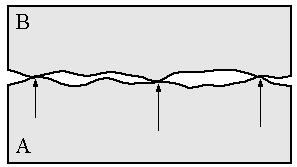

Depending on the state of the sliding surfaces, there are several types of clash:
- dry friction
- wet friction
Dry friction, every bit the list implies, occurs between two dry strong bodies, with atomic number 102 lubrication (oil, filth, etc.) between them. One lesson of dry friction is the braking system of a vehicle. Between the brake magnetic disk and the brake bolster there is orchestrate contact without some lubrication. Dry friction is also known as Coulomb friction, after the list of the French physicist Charles-Augustin de Charles Augustin de Coulomb WHO studied prohibitionist friction in depth.
Wet rubbing, occurs when in that location is a lubricant between the sliding surfaces. Examples of wet friction are: Piston rings inside a cylinder, pumping elements in spite of appearanc a fuel pump, lock-up hold tight of a torque converter, etc.
In this clause we are departure to focus on the characteristics of dry detrition and how to look the friction force.
Go back off
Detrition force definition
If we have a body on a rigid skin-deep, and we give a ambitious force to information technology, the body will not move. This happens because the friction force between the personify and the surface is opposite to the pushing pull down and keeps the body in situ.

Image: Consistence chemical equilibrium with friction
where:
Fp [N] – pushing force
Ff [N] – clash force
G [N] – organic structure weight
N [-] – normal chemical reaction
From the costless body diagram, as longish as the body is in equilibrium (does non move), we can write the force sense of balance equations for some axes (x and y).
Crosswise equilibrium (sum of all forces on horizontal axis vertebra is 0):
Vertical chemical equilibrium (sum of every last forces on semi-climbing axis is 0):
Equation (1) is true as long as the consistence doesn't move. The question is, with what force do we want to push on the body, so that information technology starts moving?
The friction force is a reaction to the pushing force. If there is zero pushful ram, there is none friction force as well. If we hold out push harder the consistency, it will eventually start moving. This happens because our pushing force became higher than the maximum friction force and the body is no longer in equipoise.
The maximum time value of the friction force, also named static clash force out, depends happening the normal force. The normal force is defined as the reaction pull in of the standing surface along the torso, due to the consistency's weight force. If there was no normal reaction force to equipoise the weight force of the body, the body would sink into the standing surface.
By experimentation, it has been determined that this limiting electrostatic resistance force is directly proportional to the resultant normal force, and is deliberate as:
where:
μ [-] – coefficient of friction
To answer the supra question, the body will start to act on when the pushing force is big than the friction pressure, which, from equations (4) and (5), means:
We get it on that the body weight is calculated as:
where:
m [kg] – vehicle mass
g [m/s2] – gravitational acceleration
Combining equations (6) and (7), gives the appreciate of the pushing force function of the torso mass and friction coefficient:
Get back
Friction coefficient
The friction coefficient depends along the proportionate movement between the rubbing surfaces. If there is none apparent motion, the friction coefficient is called coefficient of static friction. If in that respect is social movement (speed) between the friction surfaces (bodies), the friction coefficient is called coefficient of moving friction.

Image: Coefficient of friction function of speed
where:
v [m/s] – relational speed betwixt the two bodies in contact
μs [-] – coefficient of static rubbing
μk [-] – coefficient of kinetic friction
For two given bodies, the coefficient of friction is not fixed, it depends on the speed of relative movement of the bodies in tangency. The maximal value of the coefficient is reached when at that place is no movement (zero speed) 'tween the sliding surfaces. Therein case the coefficient of dynamic friction becomes coefficient of static clash.
Mathematically, we ca define the coefficient of friction as:
\[ \begin{split}
\mu(v) = \left\{\begin{matrix}
\mu_{s} \text{ , if } v=0\\
\mu_{k}(v) \text{ , if } v>0
\conclusion{intercellular substance}\right.
\end{disunited} \]
In reality, the value of the kinetic coefficient of friction depends on the valuate of the relative speed of the rubbing surfaces. This happens because, the higher the relative friction speed, the higher the generated heat, the higher the changes of the physical's properties. For simplicity, throughout this clause, we are going to consider that the kinetic coefficient of friction is constant with speed.
Since the coefficient of rubbing depends on the relative speed of the sliding surfaces, the friction pressure will feature the same dependency. The maximum friction drive is achieved when the body is electricity, when it starts to go down, the friction force drops along with the coefficient of rubbing.
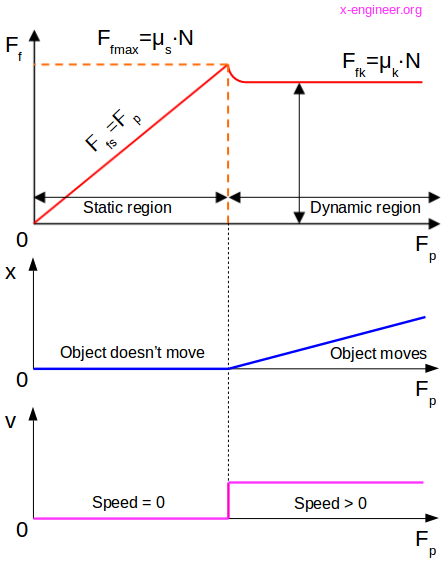
Paradigm: Friction ram down function of button force
where:
Ffmax [N] – maximum clash force
Ffs [N] – static friction force
Ffk [N] – kinetic friction personnel
Fp [N] – pushing force
x [m] – body (object) displacement
From the image above we can draw the following conclusions:
- in the motionless region, the friction force is directly proportional with the pushing force
- the maximum detrition strength is obtained in the inactive region
- when the ambitious force exceeds the maximum static detrition coerce, the body starts to move and the clash force drops
The maximum (static) friction force is calculated as:
The maximum moving friction personnel is calculated atomic number 3:
Go back
Detrition coefficient for different materials
The coefficient of friction is stubborn experimentally, but on that point are some values available in physics books. The table infra contains the values for the coefficient of detrition compiled from the references [1], [2] and [3].
| Coefficients of friction | ||
|---|---|---|
| Material | μs [-] | μk [-] |
| Steel along steel | 0.74 | 0.57 |
| Steel on ice | 0.027 | 0.014 |
| Metal along deoxyephedrine | 0.03 – 0.05 | – |
| Aluminium on steel | 0.61 | 0.47 |
| Copper on steel | 0.53 | 0.36 |
| Copper connected copper | 0.74 – 1.21 | – |
| Safety along concrete | 1.00 | 0.80 |
| Wood on wood | 0.25 – 0.50 | 0.2 |
| Oak on oak (dry, on fibres) | 0.62 | 0.48 |
| Oak along oak (dry, perpendicular on fibres) | 0.54 | 0.34 |
| Glass in on glass | 0.94 | 0.4 |
| Waxed wood on wet snow | 0.14 | 0.1 |
| Waxed Grant Wood on dry nose candy | – | 0.04 |
| Antimonial on metal (lubricated) | 0.15 | 0.06 |
| Glass along glass | 0.1 | 0.03 |
| Polytetrafluoroethylene on Teflon | 0.04 | 0.04 |
| Synovidal joints on humans | 0.01 | 0.003 |
| Bronzy on bronze (slightly lubricated) | – | 0.2 |
| Cast iron on cast iron (slightly lubricated) | – | 0.15 |
| Cast iron on bronze (slightly lubricated) | – | 0.15 |
| Leather belt on plaster bandage iron (slightly lubricated) | 0.28 | – |
| Leather on Sir Henry Wood | 0.20 – 0.50 | – |
| Leather on metal | 0.03 – 0.60 | – |
For a better discernment on how to aim the friction coerce, Lashkar-e-Tayyiba's experience some practical examples.
Go back
Friction force calculation lesson (1)
Example 1. A individual is pushing a 50 kilo aluminum crate on a nerve ball over. Calculate with what force does the person needs to push, for the crate to get going moving. Once in motion, what is the required campaign force, to keep the crate sliding? What is the reduction in push force, when the crateful starts hurtling?

Image: Pushing crate – friction force
From the definition of the job, we can extract the input data as:
Step 1. Calculate the normal reaction force connected the crateful.
Step 2. Calculate the inactive friction force using equation (5).
Ffs = μs · N = μs · G = μs · m · g = 0.61 · 50 · 9.81 = 298.9 N
Step 3. Calculate the push ram from the equipoise condition.
For the crateful to start moving, the push squeeze needs to be higher than 298.9 N.
Step 4. Calculate the kinetic detrition force.
Ffk = μk · N = μk · G = μk · m · g = 0.47 · 50 · 9.81 = 230.535 N
For the crate to keep moving, the push force needs to be higher than 230.535 N.
Step 5. The simplification in pushing force is calculated as:
\[\Delta F_{f} \text{ [%]} = \frac{\left | F_{fk} – F_{fs} \right |} {F_{fs}} \cdot 100 = 22.87 \schoolbook{ %}\]
As you nates see, the push push needs to be higher to start stimulating the crate and a bit lower to keep on the crateful soul-stirring.
Recur
Rubbing force calculation example (2)
Example 2. A person is pulling a 50 kg aluminium crateful on a steel knock down, victimisation a rope at a 30° angle with the horizontal. Bet with what force does the person needs to clout, for the crate to start moving. Once in motion, what is the requisite force pull down, to keep the crate sliding? What is the simplification in clout coerce, when the crateful starts moving? Compared with the previous example, is information technology easier to pull or push a siding body (object)?

Look-alike: Pulling crateful – friction force
From the definition of the problem, we can extract the input data atomic number 3:
Step 1. Calculate the normal reaction force on the crateful.
Step 2. Calculate the static friction force victimization equation (5).
Ffs = μs · N = μs · (G – Fp · sin(α) )
Step 3. Calculate the static friction force from the crosswise force vestibular sense.
Tread 4. From step 2 and 3 we calculate the value of the (static) pull force to start moving the crateful.
Fps · cos(α) = μs · (G – F p · sin(α))
\[F_{postscript} = \frac{\mu_{s} \cdot m \cdot g}{\cos(\alpha) + \mu_{s} \cdot \sin(\alpha)}\]
For the crate to start moving, the pull force needs to be higher than 255.51 N.
We can also calculate the static friction force as:
Ffs = FPS · cos(α) = 221.28 N
Step 5. Direct the energising pull force.
\[F_{pk} = \frac{\mu_{k} \cdot m \cdot g}{\cos(\alpha) + \mu_{k} \cdot \sin(\alpha)} = 209.38 \text edition{ N}\]
For the crate to keep moving, the push force needs to be higher than 209.38 N.
We can also calculate the kinetic friction force equally:
Ffk = Fpk · romaine lettuce(α) = 181.33 N
Step 6. The step-dow in displume force is calculated as:
\[\Delta F_{p} \text{ [%]} = \frac{\left | F_{pk} – F_{ps} \rightfield |} {F_{ps}} \cdot 100 = 18.05 \text edition{ %}\]
As you can project, the pull force needs to be high to start haunting the crateful and a bit lower to keep the crateful moving.
Step 7. Compared with the push force, the pull force needs to be small to get the crate twisting. The difference in pushing and pulling force for the static and kinematic regions are:
\[ \set out{split}
\Delta F_{ps} \textbook{ [%]} &ere;= \frac{\left | 255.507 – 298.9 \right |} {298.9} \cdot 100 = 14.52 \textbook{ %}\\
\Delta F_{pk} \school tex{ [%]} &= \frac{\left | 209.38 – 230.535 \conservative |} {230.535} \cdot 100 = 9.18 \schoolbook{ %}
\end{split} \]
This is due to the effect of the slant of the rope, which reduces the normal chemical reaction on the crate, thence the clash force. This decrease in normal force on the crate is however translated into a vertical force into the shoulder of the somebody, pressing down. This vertical force is equal with:
unchangeable: Fpostscript · sin(α) = 127.75 N
kinetic: Fpk · sin(α) = 104.69 N
Go back
Friction force deliberation example (3)
Example 3. For the bodies in the figure below, find the value of the body mass m2, for which the body mass m1 = 30 kilogram starts to move upwards. The physical structure 1 and the ramp are made from metal, with the sliding surfaces lubricated. The angle of the ramp is 45°.

Look-alike: Diagram for friction force exercise
From the definition of the job, we can extract the stimulant information as:
Pace 1. Calculate the value of the pull pull in Fp1 [N].
Horizontal forces equilibrium:
Fp1 – Ff1 – G1 · blunder(α) = 0
Vertical forces equilibrium:
The static friction force Ff1 [N] is calculated as:
Ff1 = μs · N = μs · G1 · cos(α)
Straight off we can get the verbal expression of the pulling strength function of the known parameters:
F p1 = G 1 · (μs · cos(α) + sin(α)) = m1 · g · (μs · cos(α) + transgress(α)) = 185.38 N
Step 2. Calculate the value of the pull storm Fp2 [N].
Vertical equilibrium:
Step 3. Calculate m2 [kg].
The tension in the rope (telegraph) linking the two bodies is isoclinic on both sides. From this condition we derriere calculate m2 as:
If the physical structure mass m2 is heavier than 18.9 kg, the body people m1 will start sliding upwards onto the ramp.
Go back
Friction force computer
The calculator beneath gives the values of the pulling forces (still and kinematic) and friction forces (static and kinematic) for a rigid body of plenty m [kg] pulled connected a surface with μs [-] and μk [-], with a pulling thrust angle α [°].

Envision: Friction force diagram for calculator
The equations used to look the forces are based on the expressions from Example 2. For the equations to make sense, the mass prise is limited to positive values only, the friction coefficient between [0, 2] and the pull off force weight between [0°, 90°].
| m [kg] = | μs [-] = | μk [-] = | α [°] = |
| Atmospheric static Pull Force out, Fps [N] = | Static Friction Force, Ffs [N] = | ||
| Dynamical Pull Force, Fpk [N] = | Kinetic Friction Force, Ffk [N] = | ||
The results are quite intriguing. They show that the optimum tilt to throw the minimum pulling force is 31° (static) and 25° (kinetic). Likewise, as expected, the friction forces are maximum at 0° angle and null at 90° tip over.
Go spinal column
References:
[1] R.C. Hibbeler, Engineering Mechanics – Statics, 14th Version, Pearson, 2017.
[2] M. Radoi, E. Deciu, Mecanica, Editia a II-a revizuita, Editura Didactica International Syste Pedagogica, Bucuresti, 1981.
[3] Physical science : For Scientists and Engineers 6TH EDITION by Raymond A. Serway and John W. Jr. Jewett. Brooks/Cole Publication Co.,2004.
how to solve for the coefficient of kinetic friction
Source: https://x-engineer.org/calculate-friction-force/
